
Metaphors We AI By
Early ideas about how our language and metaphors are shaping our ways of thinking about AI


TL;DR A slightly different take on what’s up with Language models and how we can think in a different direction, especially with respect to the metaphors we use to talk about AI. Check out our questions for the future here.
In 1980, George Lakoff and Mark Johnson published Metaphors We Live By, arguing that metaphors aren’t just poetic flourishes, they shape how we think. For example, we think of argument metaphorically as “war”, as so we think of ourselves as winning or losing; we defend positions, and we attack weak points. The metaphor dictates the behavior.
Forty years later, we are facing a conceptual crisis that can only be addressed by understanding how our language shapes thought in this way. We are adopting a technology that is fundamentally statistical, but we are wrapping it in metaphors that are fundamentally experiential (some may say anthropomorphic or biological, but experience is perhaps a more interesting lens).
We call it “Artificial Intelligence.” We say it “hallucinates.” We wait for it to “think.” We ask it to be “honest.”
These aren’t neutral terms. They are cognitive traps that grant these systems what we might call Unearned Agency. And this mismatch between the metaphor and the math is leading us into a dangerous valley of unwarranted trust.
The Oracle in the Clean White Room
Why do some people trust an answer from ChatGPT, Claude, or Gemini more than a well-reasoned answer from a stranger on Reddit?
It’s the interface.
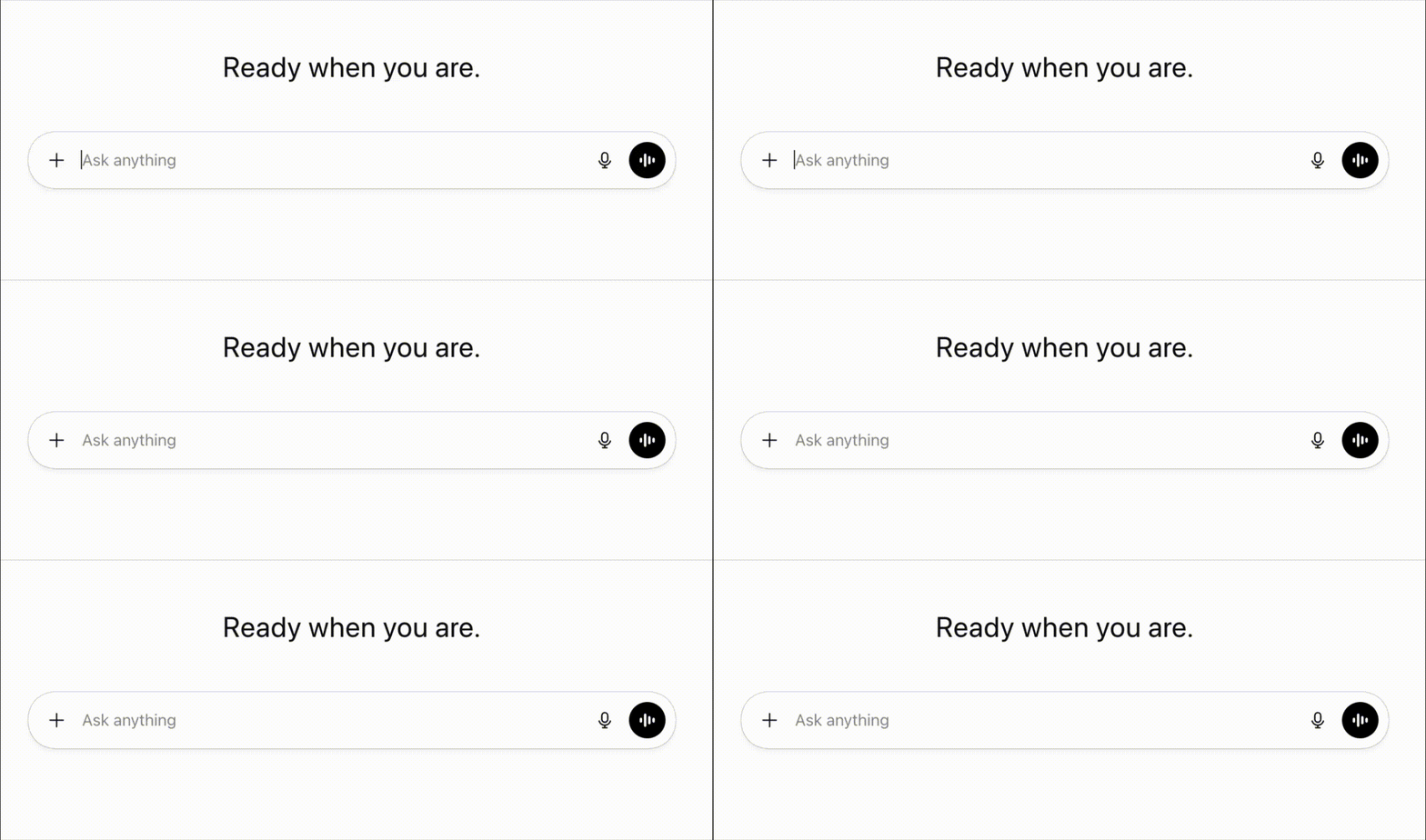
The current UX of AI is designed to reinforce the metaphor of the Delphic Oracle. The interface is sparse, clean, and authoritative. It serves as a powerful, non-verbal prop for the metaphor. It creates a dangerous conflict between what is shown by the design and what is declared by the fine print. We can plaster “AI may display inaccurate info” warnings all over the screen, but the interface affirms authority. In a contest between a visceral interface metaphor and a written disclaimer, the interface wins. We trust the Oracle we see over the warning label we read.
This design obscures the reality: you are effectively playing a slot machine of language. You put one token in, and you get five tokens out. But because the metaphor is “Conversation with an Oracle” rather than “Querying a Database,” we lower our guard. We assume intent where there is only probability.
One of our colleagues recently put it: “The fuzziness is a feature.”
We humans are “messy.” We communicate in fragments, typos, implied contexts, and emotional shorthand. We type “u up?” or “explain quantum physics like I’m 5 plz.” We rely on shared history and biology to fill in the gaps. When we say we “understand” each other, we aren’t just parsing syntax. We are predicting what the other expects, matching or expanding their worldview, and fitting our response within a shared constraint space. Crucially, this is rooted in physical embodiment. We know that language never fully captures “worldly” experiences, the smell of rain, the weight of grief, so we rely on that shared biological reality to carry the meaning.
The AI, conversely, is “clean.” It has no history, no biology, no physical body to ground its language, and no bad days. It takes our jagged, messy input and runs it through a statistical thresher, smoothing out the rough edges until it produces a perfectly grammatical, confident, and structured response.
This transition from Messy Input to Clean Output is where the illusion of intelligence lives. When we see a clean answer, we instinctively assume a clean thought process preceded it. We assume the machine “understood” the messiness. But it didn’t understand you the same way another person understands you (and deep down we hope you take a moment to think about what this means). It has no worldview to expand, no shared constraints, no lived context to respect.
It just statistically predicted that the most likely response to your messy input was a clean output. It is a “fuzzy” translator, bridging the gap not through empathy, but through probability. It smoothes over our imperfections, and in doing so, tricks us into seeing a reflection of a mind where there is only a matrix of weights.
The Illusion of Focus: Attention and the Context Window
This statistical sleight of hand is powered by two of the most anthropomorphized concepts in the industry: Attention and the Context Window.
In human terms, “attention” is a finite cognitive resource, usually an act of will. When you pay attention, you are consciously prioritizing. In a Transformer model, however, “Attention” is simply a mathematical weight assigned to a token. It is a massive, multidimensional matrix calculating which bits of data correlate most strongly with other bits. It isn’t “focusing” because it finds a topic interesting; it is merely multiplying vectors.
Similarly, we talk about the “Context Window” as if it were a digital version of short-term memory. We marvel at models that can “remember” a hundred-page document, comparing it to a human genius with a photographic mind. But the model doesn’t “remember” the beginning of the prompt while it writes the end. It doesn’t hold a thought in its head. (It doesn’t have a head!) The context window is simply the boundary of the mathematical calculation, the limit of how many tokens can be processed in a single pass, given certain technical constraints.
When the window fills up, the “memory” doesn’t fade like a human thought; it simply ceases to exist for the next calculation. By using these terms, we imply a similarity and continuity of consciousness that doesn’t exist. We mistake a sophisticated buffer for a sentient mind. Speaking of which…
The Trap of “Hallucination”
Consider the term Hallucination.
When an LLM fabricates a legal precedent or invents a historical fact, we say it “hallucinated.” We’ve (the authors) never liked this misnomer of a metaphor. Hallucination implies a biological mind that is temporarily perceiving reality incorrectly. It implies that there is a “sane” version of the AI that knows the truth, but is currently having a bad day due to mental illness. When we frame an LLM as a person, our epistemic and moral expectations of a person become central—we expect truth-telling and accountability, and our only explanation for obvious non-truths is that the model is like a person who occasionally loses grip with a shared reality. But when we frame an LLM as a “word calculator” or stochastic parrot, those expectations shift, and representative pattern completion becomes the central metric.
A better metaphor for what LLMs do is Improv.1
In improv theater, the golden rule is “Yes, And...” You never reject the premise; you build on it to keep the scene flowing. If you tell an LLM, “Tell me about the time Barack Obama flew over the Golden Gate Bridge,” it might not stop to check a fact database (this depends on the size and quality of the LLM). It may just look at the linguistic pattern and say, “Yes, and he did it on a foggy Tuesday...”
It isn’t lying to you. It isn’t hallucinating. It is successfully completing the pattern you started. It is a Stochastic Parrot, mimicking the linguistic shape of “truth” (knowledge that most people agree is factual, expressed as a linguistic pattern) without the substance of an embodied conscious reality. This distinction - between truth and the shape of truth - is critical because so much of our theory of mind comes from embodied observations that we believe are independent of our own subjectivity, but congruent with our shared mental models of the world. Even when we attribute “understanding” to animals, we do so because we share a physical reality. Extending this notion of understanding and sharing a reality to LLMs is factually incorrect and opens us to the worst risks of anthropomorphizing (flagpole planted).
From Explorers to Sanitation Workers
The metaphors we use for AI don’t just change how we view the code come to life; they change how we view ourselves.
For the last twenty years, the dominant metaphor for the internet user was the Explorer or the Librarian. We “surfed” the web. We “searched” for answers.
With the rise of generative AI, we are seeing the rise of “AI Slop”. This is seemingly infinite, low-cost content generated to fill space, communicate knowledge, or feign intelligence. The internet is no longer a library; it is a polluted river (and we as a society feel the weight of this more every day).
Our role is shifting from Explorer to Sanitation Worker. We are no longer searching for the gem; we are spending extra cognitive cycles filtering out the sludge.
There is a massive social cost to this filtering. We want to acquire facts, not spread misinformation, but the “sludge” moves faster than the truth. It spreads like wildfire, virally and uncontrollably. And once a plausible falsehood takes hold, you can’t take it back, you can’t “cancel” the damage done to our shared reality.
Simultaneously, we are becoming Wizards. The rise of “Prompt Engineering” has introduced a metaphor of spellcasting. If you can just find the right incantation, the right combination of “abracadabra” words, you can bind the demon / daemon to your will. This reinforces the idea that the AI is a mysterious, semi-sentient spirit that must be coaxed, rather than a software tool that must be debugged. (Don’t even get us started on the usage of sparkle iconography + magic metaphors used frequently in AI UX.)

The Feedback Loop
Here is our deepest concern: AI models are trained on our writing. If our writing is full of specific metaphors (e.g., “The Brain is a Computer”), the AI will ingest that metaphor and spit it back out at us as objective fact.
We risk creating a closed loop where our cultural biases are encoded into the model, validated by the model’s “authority,” and then fed back to us, narrowing the window of human thought to the statistical mean of Western writing from the last century.
Questions for the Future
As we integrate these tools deeper into our lives, we need to ask:
If we view AI as a “Partner” or “Co-pilot,” who is liable when the plane crashes? The metaphor of agency shifts blame away from the developer and onto the “Ghost in the Machine.” It also forces us to ask: Where does the expertise reside? How does authority shift between the human and the system? If we view the AI as a peer, we risk deferring to it, assuming it possesses an expertise that is actually just statistical probability.
Can we design interfaces that lower inaccurate trust while building useful trust? We need to lower the trust that assumes intent, agency, and consciousness, while ramping up the trust in its mechanical consistency. What would a “truthful” AI interface look like? Perhaps it should look less like a chat window and more like a slot machine or a linguistic calculator.
Are we confusing “Fluency” with “Thought”? Just because the machine speaks perfect English, does that mean it knows what it’s saying? Or have we just built a very expensive mirror that reflects our own language back at us?
We need new metaphors. We need to see these systems not as Oracles or Brains, but as Bulldozers for Text or Imagination Amplifiers. Powerful, mechanical, and entirely dependent on the operator to steer themselves away from the cliff. Unlike the dominant metaphors of the “Oracle” or “Unknowable Superintelligence”, which encourage us to passively receive wisdom or fear an alien mind, these mechanical metaphors demand active engagement and accountability management. They remind us that the output is a product of leverage, not thought. You don’t trust a bulldozer without inspecting its work. You don’t argue with an amplifier; you adjust the gain. This shift is crucial because it relocates expertise and accountability back to where it belongs: with us, the human users of these technologies.
See this article by Helen Toner.
 | A guest post by
|
 | A guest post by
|
 | A guest post by
|
This is really great.
A reader of mine on twitter pointed me over here in a comment under my post about this article--I think we have some similar angles!
https://kylesaunders.substack.com/p/reality-bats-last-part-1-of-2